
'Favourable product mix, sales recovery, and cost saving initiatives are expected to support margins going ahead while focus on debt reduction (target of debt free by FY24) will aid balance sheet strength'
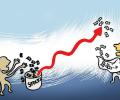
Small stocks made a dashing comeback in 2020 after delivering negative returns in the last two years as increased retail investor participation in pandemic times saw small-cap index surging up to 31 per cent and outperforming the bigger benchmark gauge. This year turned out to be eventful for the equity market, witnessing bearish and bullish sentiments at different points of time. While the initial part of COVID-ravaged 2020 saw the bears in full force amid concerns related to the pandemic and lockdowns hurting economic activities, bulls made a comeback towards the latter half of the year. As the market swayed with many lows as well as highs, small and mid-cap indices emerged as markets favourites in 2020.

The social impact of this could be worse as 300 million subscribers may face the annoyance of network shutdown and churn.

Growth concerns on China, which has already seen the yuan getting devalued twice in August, have rattled global financial markets, including that of India.

Gold, which was hovering around $1,321 an ounce in January 2019, has already breached $1,600 per ounce in the past few sessions to a seven-year high.

tailwinds of a remarkable year and handsome investor returns, Indian equities are set for an eventful journey in 2024, with a slew of local and global cues -- varying from interest rates to Lok Sabha polls to geopolitical happenings. Analysts are of the view that the bull run in the domestic equity market will continue, and over the next 3-6 months, the benchmark indices -- Sensex and Nifty -- could climb up to 7 per cent. In 2023, the 30-share BSE Sensex jumped 11,399.52 points or 18.73 per cent, and the NSE Nifty climbed 3,626.1 points or 20 per cent.

'Experts are not ruling out further pain as global factors cannot insulate India from the aftermath.'


Some of the sops being offered to rope in new clients and retain the existing ones are cashbacks, reduced fee, and customised consultancy for clients.

Dhanteras' buying seemed to have been sparked by the belief that prices would remain firm

The share of public sector undertakings (PSUs) in the total market capitalisation of listed companies--at an all-time low of 10 per cent currently --- may get a leg-up from the government's divestment push. Recently the government announced the successful sale of national carrier Air India to Tata Sons, India's first privatisation of a PSU since 2002-03. The transaction is expected to be completed by December.

'Large-caps are better placed to withstand the impact of higher input cost inflation, rising rates and withdrawal of excess global liquidity.'

Analysts say traders have been building long positions on expectations the BJP would sail through in the five Assembly elections

Experts say a turnaround may happen after the general elections.

In a memorable year for the equity market, Dalal Street investors added a whopping Rs 81.90 lakh crore to their wealth in 2023 as a raft of positive factors powered a stellar rally in stocks. Experts said India's strong macroeconomic fundamentals, political stability owing to the BJP's success in recent elections in three significant states, optimistic corporate earnings outlook, signals from the US Federal Reserve about three prospective rate cuts next year and heavy retail investors participation played a major role in fuelling the stock market rally in 2023. In the year 2023, the 30-share BSE Sensex jumped 11,399.52 points or 18.73 per cent.

Portfolio management services (PMS), catering to higher networth individuals (HNIs), are facing tough competition from emerging alternative investment funds (AIFs), evident from their dwindling client base. In May, the number of clients for the industry stood at 125,390, down 20,528 in two months, shows data from the Securities and Exchange Board of India (Sebi). "PMS managers also have a high active ratio, which means their portfolios are quite differently positioned and more actively managed, compared to the benchmark, which is also a highlight for long-term investors.

Logistics services provider Delhivery is likely to launch its downsized initial public offering (IPO) this week, said people in the know. The Softbank-backed firm may trim its issue size from Rs 7,460 crore to Rs 5,500 crore to align with the volatile market conditions, sources said. Sources added the fresh issue component of the IPO could be reduced to Rs 4,500 crore and the OFS component to Rs 1,000 crore.

According to fund managers, expectations of a 25-basis-point increase in the cash reserve ratio of banks have heightened in the wake of RBI's surprise twin moves to make short-term money dearer as part of its attempts to curb the rupee's volatility.

HNI investors need an optimal mix of oversubscription and listing-day gain to make money on leveraged bets, notes Sanjay Kumar Singh.

While HDFC Bank has vowed to recoup its lost market share in the credit card segment in three to four quarters by aggressively sourcing new cards, brokerages believe it is a little hard to come by, given how competitive the landscape has become, with other players in the market becoming equally aggressive to gain market share. Kotak Institutional Equities in its report on Monday said, "We would like to believe that the recovery in market share is likely to be gradual, if any. "All the key players, including Axis Bank, are now willing to expand their credit card portfolios as they have tested quite well against Covid-19."

Investors are already factoring in the impact. The IT Index on the BSE exchange dipped 2.5 per cent, with Infosys, Wipro and TCS showing a decline.

rediffGURU and financial planning expert Colonel Sanjeev Govila (retd) answers your personal finance-related questions.

Auto, pharma, IT, chemicals among sectors with significant reliance on UK and European nations with Tata Motors, Motherson Sumi, Tata Steel, TCS, Wipro, Infosys and Tech M among key names.

The stock of auto component major Bosch was up 2.5 per cent on Wednesday and in the process hit its 52-week high. Expectations of higher volumes of medium and heavy commercial vehicles' (M&HCV), rise in content supplies on account of BS VI stage 2 implementation from April, and improved profitability are some of the positives for the stock. In addition to this, the company appointed a new managing director and joint managing director last week, which will come into effect from July 1.

Brokerages expect Nifty50 companies to have cumulatively witnessed strong double-digit growth in their earnings in the first quarter of FY24 (Q1FY24). This growth in the combined earnings is expected to have been driven by banks, automakers, and oil & gas companies. Other sectors may report muted profit growth.
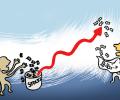
'The good news is that money continues to flow into India-focussed offshore funds.'

Analysts say investors should increase their exposure to gold up to 10% of their portfolio, depending on their comfort with a 2-year horizon. But avoid investing in physical gold or deposit schemes run by jewellers

Despite returns from gold down over 5% in the past three months, it is a good idea to keep this asset class in your portfolio.

The rupee appreciated 7 paise to 79.74 against the US dollar in early trade on Thursday as a positive trend in domestic equities supported the local unit. However, a strong American currency overseas and forex outflows restricted the rupee's gain, dealers said. At the interbank foreign exchange, the rupee opened at 79.72 against the American dollar, then went lower to trade at 79.74 against the greenback in early deals, registering a gain of 7 paise over the last close.

The progress of the GST Bill in Parliament is also likely to remain in focus

While some companies, such as HSBC, have closed retail operations, big players such as India Infoline is scaling down.

According to experts, the Nifty has continued to form lower top-lower bottom formations, a trend seen in the last five weeks, and witnessed sharp selling towards 9,700 zones.

In the first eight months of 2019, 70 per cent stocks in the BSE 500 universe were down. These stocks account for 94 per cent of India's total market capitalisation.

Top companies in China are valued at 7.7 times the trailing 12-month earnings against a P/E ratio of 18.6 times for Nifty 50 companies.


The June quarter numbers of the country's largest listed healthcare services provider, Apollo Hospitals Enterprise (Apollo), were in line with Street estimates on the operational front. Net profit estimates, however, missed expectations due to higher interest and tax outgo. The revenue performance of the core hospital segment was robust, registering a 13 per cent increase over the year-ago quarter.
Given the uncertainties around gold's future course, stagger your purchases and buy on declines, says Sanjay Kumar Singh.

India's rupee is likely to remain under pressure due to high prices of crude oil and other commodities, and may stabilise at around 79-80 against the US dollar in the near term, say experts amid limited headroom available with the Reserve Bank to check the weakening of the domestic currency. The currency has slumped over 5 per cent this year after Russia's invasion of Ukraine sent international crude oil prices soaring to a decade high. On Monday, rupee ended at a fresh all-time low of 78.34 (provisional) against the US dollar.

Raamdeo Agrawal, joint managing director at Motilal Oswal Financial Services, tells Sheetal Agarwal key trends in this earnings season and investment themes in Indian markets.
Such an economic environment tends to be positive for gold, the ultimate safe-haven asset. Since gold cannot be debased by central banks, it naturally gains in value.
 © 2026 Rediff.com - Investor Information - Advertise with us - Disclaimer - Privacy Policy - Sitemap - Feedback - About us - Terms of use - Grievances